<?xml version="1.0" encoding="utf-8"?><feed xmlns="http://www.w3.org/2005/Atom" ><generator uri="https://jekyllrb.com/" version="3.10.0">Jekyll</generator><link href="https://pmwhileblack.com/feed.xml" rel="self" type="application/atom+xml" /><link href="https://pmwhileblack.com/" rel="alternate" type="text/html" /><updated>2026-11-13T02:33:55+00:00</updated><id>https://pmwhileblack.com/feed.xml</id><title type="html">PM</title><subtitle>PM While Black: making product management careers more accessible to the Black community.</subtitle><entry><title type="html">How do you become a product manager?</title><link href="https://pmwhileblack.com/2025/03/17/how-does-one-become-a-product-manager/" rel="alternate" type="text/html" title="How do you become a product manager?" /><published>2025-03-17T01:57:21+00:00</published><updated>2025-03-17T01:57:21+00:00</updated><id>https://pmwhileblack.com/2025/03/17/how-does-one-become-a-product-manager</id><content type="html" xml:base="https://pmwhileblack.com/2025/03/17/how-does-one-become-a-product-manager/"><![CDATA[<div class="wp-block-image"><figure class="aligncenter is-resized"><img loading="lazy" src="https://images.pexels.com/photos/3967020/pexels-photo-3967020.jpeg?auto=compress&amp;cs=tinysrgb&amp;h=750&amp;w=1260" alt="Positive ethnic couple working together with documents while sitting at round table" width="354" height="283" /></figure></div>


<p class="wp-block-paragraph">For so many fields, this style of question is pretty straight-forward.</p>


<p class="wp-block-paragraph">Want to be a software engineer? Study computer science at a four-year institution, get decent grades, do an internship or two, and do decent at full-time interviews. </p>


<p class="wp-block-paragraph">Want to be an accountant? Study accounting, get decent grades, do an internship or two, and do decent at full-time interviews.</p>


<p class="wp-block-paragraph">There are many fields where the path is much less clear &#8211; product management is one of them.</p>


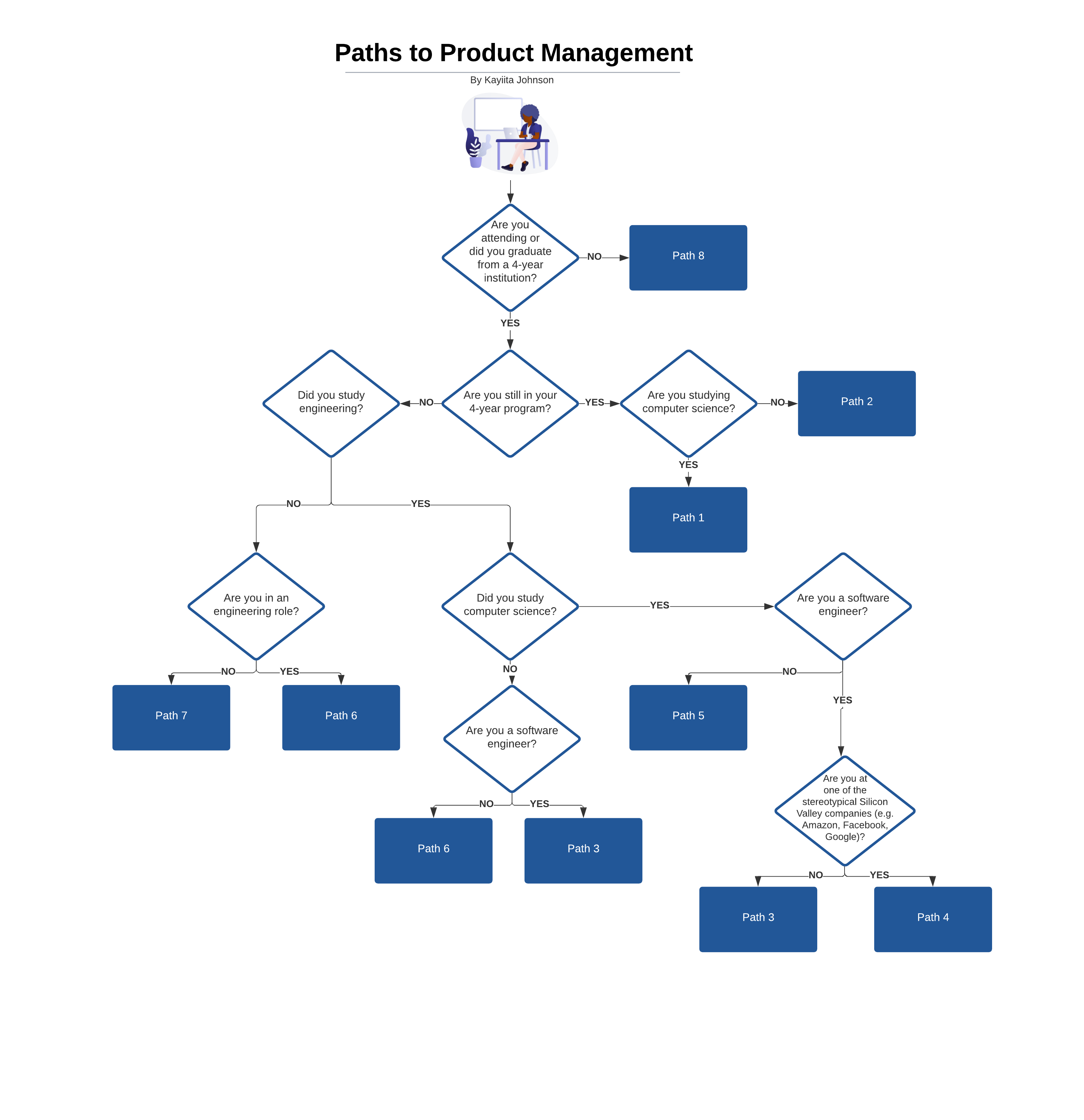
<p class="wp-block-paragraph">I get this question all the time, and the short answer is lame &#8211; it depends. The reality is, the answer to this question varies greatly according to your background. It also depends on what you mean exactly by product management e.g. industry or scope of work. Thus, I have created a choose-your-own-adventure diagram for you to enjoy 🙂 Simply answer the questions in the diagram to determine the right passage for you to read below.</p>


<p class="wp-block-paragraph">Note: this covers product management at high tech/software/Silicon Valley companies. Much of this advice does not necessarily pertain to other industries.</p>


<p class="wp-block-paragraph">Note 2: if I list a program like MLT, an internship program or business school, <strong>get ahead of the deadlines</strong>. So many people end up looking up the deadlines too late and missing what could have been a perfect opportunity for them, all because they procrastinated on understanding the timelines. <strong>Do not block your dreams because you didn&#8217;t take the time to know the due dates!</strong></p>


<figure class="wp-block-image size-2048x2048"><img src="/assets/uploads/2025/02/faccc-image-1.png" alt="" class="wp-image-164" /></figure>


<h3 class="wp-block-heading"><strong>Path 1</strong> &#8211; <strong>computer science (CS) major in undergrad</strong></h3>


<p class="wp-block-paragraph">The path for this person will differ based on your institution, your year, your GPA, and your internship experience.</p>


<p class="wp-block-paragraph">Assuming you are a freshman at an elite U.S. college with a high GPA (generally need to shoot for &gt;3.5 IMO), focus on obtaining SWE internships &#8211; ideally at a FANG company. Often, I will see CS majors at elite colleges do a few internships at FANG companies prior to doing a PM internship after their junior year, or apply to the entry-level product management program at the company they have been interning at. </p>


<p class="wp-block-paragraph">If you are a sophomore, focus on getting those SWE internships as well as networking. Ideally, you would also apply for MLT&#8217;s career prep. It is a program that will fast track your path to a major company and can likely increase your chances of becoming a product manager in the future.</p>


<p class="wp-block-paragraph">If you are a junior, focus on again getting those SWE internships but start networking and do informational interviews with those in PM roles at the companies you are interested in. Determine if it makes more sense to apply to PM roles for full-time or if it makes sense to work as a SWE for a few years and then transition (see Path 4).</p>


<p class="wp-block-paragraph">If you do not have a high GPA, <strong>get that ish</strong> <strong>UP</strong>! These companies do no play when it comes to academics, and neither should you. If you are not at an elite institution, you can still get on this track but it will just require more effort. Inquire at your career services office and find out how you can get to CS internships at major companies and ask them to show how one can become a product manager straight out of their school. Ask them to connect you with alumni that have made the leap to PM or have transitioned into it. This is their job, so asking them to do it <strong>isn&#8217;t a bad thing</strong>. </p>


<h3 class="wp-block-heading"><strong>Path 2</strong> &#8211; <strong>non-CS major in undergrad</strong></h3>


<p class="wp-block-paragraph">The path for this person will differ based on your institution, your year, your GPA, and your internship experience.</p>


<p class="wp-block-paragraph">Generally, it is harder to become a PM in this path than in Path 1, but it is definitely still doable. If you want to become a PM immediately after college, consider doing LinkedIn searches of those that became PMs at major companies right after undergrad (ideally your institution) and had your undergrad major or something similar. This will help you understand how people have navigated to these roles in the past. Again, having a high GPA (&gt;3.5 at least) and being at an elite institution go a long ways here.</p>


<p class="wp-block-paragraph">If you are a sophomore, definitely apply to MLT Career Prep. They have a technical track that could help increase your chances to become a PM.</p>


<p class="wp-block-paragraph">Additionally, I would get some decent CS experience. This could include taking classes up to data structures and algorithms, creating a mobile app or some other technical project. At the end of the day, product managers need to interact with engineers and grapple with tough technical conversations in order to make product trade-offs for the optimal user experience. If you haven&#8217;t familiarized yourself with that world, it will be very tough to be an effective product manager.</p>


<p class="wp-block-paragraph">You can also wait until you have spent some years working out of school. Read path 6 or 7 for more information.</p>


<h3 class="wp-block-heading"><strong>Path 3</strong> <strong>&#8211; working as a software engineer</strong></h3>


<p class="wp-block-paragraph">Generally, my advice would be to either transition to a company where they offer PM transition programs for SWEs, or attend business school. </p>


<p class="wp-block-paragraph">At several major Silicon Valley companies, there are PM rotation programs for those in software engineering (SWEs). Generally, SWEs work for several years and then begin to join their company&#8217;s PM rotation program. At that point, they can recruit for a full-time PM role at their company.</p>


<p class="wp-block-paragraph">If you are not interested in that path, you could also attend business school and become a product manager. The bigger tech companies tend to prioritize CS undergrad majors for MBA internships, so you would have a great opportunity to become a PM. I would recommend applying for MLT MBA Prep, as it increases your chances of going to a top-tier business school &#8211; this in turn increases your chances of landing a PM internship and eventually a full-time PM offer post-business school.</p>


<p class="wp-block-paragraph">Lastly, you could take a course in product management that <em>explicitly states they will place you into a PM role</em>. Try to avoid the courses that do not make that an explicit promise and/or high-priority goal, as you may end up with some knowledge and skills but no role to put them into practice.</p>


<h3 class="wp-block-heading"><strong>Path 4 &#8211; software engineer at a stereotypical Silicon Valley company (FANG)</strong></h3>


<p class="wp-block-paragraph">First of all, congratulations! It is very difficult to get to this path and you should be proud of yourself. In this path, there are multiple ways to become a PM. </p>


<p class="wp-block-paragraph">At several major Silicon Valley companies, there are PM rotation programs for those in software engineering (SWEs). Generally, SWEs work for several years and then begin to join their company&#8217;s PM rotation program. At that point, they can recruit for a full-time PM role at their company.</p>


<p class="wp-block-paragraph">If you are not interested in that path, you could also attend business school and become a product manager. The bigger tech companies tend to prioritize CS undergrad majors for MBA internships, so you would have a great opportunity to become a PM. I would recommend applying for MLT MBA Prep, as it increases your chances of going to a top-tier business school &#8211; this in turn increases your chances of landing a PM internship and eventually a full-time PM offer post-business school.</p>


<p class="wp-block-paragraph">Lastly, you could take a course in product management that <em>explicitly states they will place you into a PM role</em>. Try to avoid the courses that do not make that an explicit promise and/or high-priority goal, as you may end up with some knowledge and skills but no role to put them into practice.</p>


<h3 class="wp-block-heading"><strong>Path 5 &#8211; CS undergrad not working as a software engineer</strong></h3>


<p class="wp-block-paragraph">Generally, my recommendation here would be to attend business school. As an engineer, you are generally in a better position to get into business school. Additionally, many product managers have MBAs nowadays and this could serve as a strong transition tool. The bigger tech companies tend to prioritize CS undergrad majors for MBA internships, so you would have a great opportunity to become a PM. I would recommend applying for MLT MBA Prep, as it increases your chances of going to a top-tier business school &#8211; this in turn increases your chances of landing a PM internship and eventually a full-time PM offer post-business school.</p>


<p class="wp-block-paragraph">If you are a management consultant working at MBB (one of the three premier consulting firms &#8211; McKinsey, Bain or BCG), there are ways to transition directly into product management without attending business school. My recommendation would be to do a LinkedIn search of those that are PMs today that were at your consulting firm previously and did not obtain an MBA. Ping those people to ask for informational interviews and a decent proportion will respond.</p>


<h3 class="wp-block-heading"><strong>Path 6 &#8211; non-CS undergrad but has another engineering degree or engineering experience</strong></h3>


<p class="wp-block-paragraph">Generally, my recommendation here would be to attend business school. As an engineer, you are generally in a better position to get into business school. Additionally, many product managers have MBAs nowadays and this could serve as a strong transition tool. The bigger tech companies tend to prioritize CS undergrad majors for MBA internships, but those with engineering experiences can certainly leverage that in the application process. I would recommend applying for MLT MBA Prep, as it increases your chances of going to a top-tier business school &#8211; this in turn increases your chances of landing a PM internship and eventually a full-time PM offer post-business school. I have also noticed that big tech companies value &amp; sometimes prioritize interviewing you when their competition provides you with an offer, so keep that in mind as well.</p>


<p class="wp-block-paragraph">If you are a management consultant working at MBB (one of the three premier consulting firms &#8211; McKinsey, Bain or BCG), there are ways to transition directly into product management without attending business school. My recommendation would be to do a LinkedIn search of those that are PMs today that were at your consulting firm previously and did not obtain an MBA. Ping those people to ask for informational interviews and a decent proportion will respond.</p>


<h3 class="wp-block-heading"><strong>Path 7</strong> <strong>&#8211; non-technical undergrad, working professional</strong></h3>


<p class="wp-block-paragraph">Generally, my recommendation here would be to attend business school. Though you do not have a technical degree, you can take coding courses at school and intern as a PM at a company that does not have a hard technical degree requirement, such as Amazon. Many product managers have MBAs nowadays and this could serve as a strong transition tool. I would recommend applying for MLT MBA Prep, as it increases your chances of going to a top-tier business school &#8211; this in turn increases your chances of landing a PM internship and eventually a full-time PM offer post-business school. I have also noticed that big tech companies value &amp; sometimes prioritize interviewing you when their competition provides you with an offer, so keep that in mind as well.</p>


<p class="wp-block-paragraph">If you are a management consultant working at MBB (one of the three premier consulting firms &#8211; McKinsey, Bain or BCG), there are ways to transition directly into product management without attending business school. My recommendation would be to do a LinkedIn search of those that are PMs today that were at your consulting firm previously and did not obtain an MBA. Ping those people to ask for informational interviews and a decent proportion will respond.</p>


<p class="wp-block-paragraph">If you are a product marketing manager, I have also seen people transition directly into product management. Again, I would perform a similar LinkedIn search as above to understand the path ahead of you.</p>


<h3 class="wp-block-heading"><strong>Path 8</strong> <strong>&#8211; no four-year degree but working professional, or still in high school</strong></h3>


<p class="wp-block-paragraph">If you are still in high school, congratulations! You are doing the right thing by really thinking ahead and determining the best path forward for yourself. I would recommend just reading through the paths, mainly Path 1 &amp; Path 2.</p>


<p class="wp-block-paragraph">For those who are working professionals but do not have a four-year degree, this certainly will be difficult but it can be done. For those in this situation, having extraordinary impact is what can really improve your chances. For example, launch a successful technology business. Doing so indicates your ability not only to lead a team, raise funds and grow a business, but also demonstrates an ability to determine the right product and feature set to satisfy consumer needs &#8211; skills that are in high demand for product management roles.</p>]]></content><author><name>Kayiita Johansson</name></author><summary type="html"><![CDATA[]]></summary></entry><entry><title type="html">Example Product Interview Answer: Next Killer Feature</title><link href="https://pmwhileblack.com/2020/10/07/example-product-interview-answer-next-killer-feature/" rel="alternate" type="text/html" title="Example Product Interview Answer: Next Killer Feature" /><published>2020-10-07T16:08:13+00:00</published><updated>2020-10-07T16:08:13+00:00</updated><id>https://pmwhileblack.com/2020/10/07/example-product-interview-answer-next-killer-feature</id><content type="html" xml:base="https://pmwhileblack.com/2020/10/07/example-product-interview-answer-next-killer-feature/"><![CDATA[<p class="wp-block-paragraph"><em>Editor&#8217;s note: in the <a href="/2020/05/24/prep-for-pm-interviews-at-large-tech-firms/">interview prep post</a>, we reference product questions as a key area to practice for product management interviews. <a href="https://www.linkedin.com/in/meka-este-mcdonald/">Meka</a> from <a href="http://getsote.com/">Sote</a> has done us the kindness of laying out his thought process and answer to a certain product question. Enjoy!</em></p>


<p class="wp-block-paragraph"></p>


<h2 class="wp-block-heading">Q: Imagine you were a PM at Google.  If you were to build the next killer feature for them, what would it be?</h2>


<h3 class="wp-block-heading"><strong>Background (The Setup)</strong></h3>


<p class="wp-block-paragraph">If I were to answer this, there are a couple different paths you could go.  You could go with a new product line within an existing revenue stream.  But since so many of Google’s revenue streams are mature, it would be hard to imagine a single new feature making a big impact.  You could try to create a new revenue stream from an existing product line, but that is more of a strategic question than a product vision question.  That is why I would look at both: a new product line that creates a new revenue source. But even that is a super open-ended question, so I&#8217;m going to try to come up with some constraints that will give my creativity a target to hit. So one lens of looking at this is something that I got from <a href="https://stratechery.com/2014/business-models-2014/">Stratechery</a>: what types of tech business models are capable of generating billions in revenue?</p>


<p class="wp-block-paragraph"></p>


<figure class="wp-block-image"><img src="https://lh6.googleusercontent.com/SjjwzjLbTfpGYbJzHqfs7iQoOuqVW6preSTV9FLBH-q6947Y0x-3R691SiAVwhnkv4czi8WmG9Xg5hXurgyQClpVwvme_-zcpV_hpq3znrLZQyA4QFRoGB1RvK-aNrbq8AmacBW2" alt="" /></figure>


<p class="wp-block-paragraph"></p>


<p class="wp-block-paragraph">Google has already begun to diversify their product lines across these different business models, but clearly the vast majority of its revenue is generated by ad-supported consumer products &#8211; namely Search. So already, I&#8217;m thinking one constraint would be to beef up one of the other business model types.</p>


<p class="wp-block-paragraph">I really like to use interesting intersections as ways to get my creativity going. Another &#8220;vector&#8221; of constraints that we could consider is something I really liked from the Stratechery article’s suggested reading, <em>Escape Velocity</em>, where he talked about the different horizons.</p>


<p class="wp-block-paragraph"></p>


<figure class="wp-block-image"><img src="https://lh5.googleusercontent.com/vSPnr2uJfsWFoGjoNIMjfK9LZ80BlSJNpfmZvMKCm6LLRSFzvOl1rjFRVZ0B0QVPVwzN30V832dKFE5bfOcgvqp-0rWvpo4jplJo05H1WJ3mAvnr4ELVp7JQlZKKfPkbVXMg6Z3p" alt="" /></figure>


<p class="wp-block-paragraph"></p>


<p class="wp-block-paragraph">When I think about Google, I think of Google X, which is providing a lot of bets in Horizon 3. I think of Mothership Google, which has a number of interconnected product lines around its ad business. And while you could argue that Google has a few Horizon 2 bets, my gut feeling is that this is the area that Google needs to strengthen. So far, our target looks like this:</p>


<p class="wp-block-paragraph"></p>


<figure class="wp-block-image"><img src="https://lh4.googleusercontent.com/8viM5cQ_dFBxL-zv3RAtG864kOsfbE7hXmXcmw9y3AYciIfAP8bTaYc3sSitYYPEFhlN_cgfXsJuTjROp6rA2o_aZgB0Lh2inIqwZPygnRWU2T7FKauL8LytR9KTC1hGW_4hyTLf" alt="" /></figure>


<p class="wp-block-paragraph"></p>


<p class="wp-block-paragraph">Now we need a way to determine what things might be Horizon 2, and <em>Escape Velocity </em>provides another interesting vector we can use to think about this: category power. <em>Emerging</em> categories are ones that will fall into Horizon 3, <em>Growth </em>categories are ones that haven&#8217;t been won but are on the cusp of generating significant returns for the winners and often fall in Horizon 2, and <em>Maturing </em>categories are in market share battles but the pie is no longer growing and fall in Horizon 1. We will want to focus on Growth categories that Google has some core competency in already.  From following Google, I would say they are well known for AI and machine learning (Google Home, Search), Cloud services competing with AWS, and OS’s for IoT (Android Auto, Pixel Watch).  So our target now looks like this:</p>


<p class="wp-block-paragraph"></p>


<figure class="wp-block-image"><img src="https://lh6.googleusercontent.com/_S04Z5g5FVvMb_qWUJY1NnG1fgAK5TMo7e-wwjjjB8lYEaeRk2fBI6SsG4OtK1X1Sc97uxI-dkB80-NfQ4YJ7M6ePDO8vrWME-OKF9VWM5WQIuRik4Q3aZ8XragMJFXHcspgCwjm" alt="" /></figure>


<p class="wp-block-paragraph"></p>


<p class="wp-block-paragraph">Looking at that Venn diagram as a guide, the intersection of these three categories are where we’d like to develop that next killer feature.</p>


<h3 class="wp-block-heading"><strong>Goals and Constraints:</strong></h3>


<p class="wp-block-paragraph">So our target is both the goal and the constraint: to enter a growing category in a way that leverages Google’s current strengths, but only if they can make it material to the business in 2 years.</p>


<h4 class="wp-block-heading"><strong>Constraints</strong></h4>


<p class="wp-block-paragraph">Often personas are used at this stage, helping to put further constraints on the problem you are trying to solve.&nbsp; But in this case, I think it is more instructive to use combinations of business model and category, which builds off the work we’ve done so far:</p>


<figure class="wp-block-image"><img src="https://lh5.googleusercontent.com/MmoYb3M-xXPvyH13y8aL7TPcJ-A9rqxzZPy5XV90H0BRGAWY-30Nu1zVZPROcOFb45MtgfsKyT0emv2ojp7xIzgGHNM1_qenrEpwL7nluegbRcHI6uwlBkBJaZeUfPxM_9PK41Pj" alt="" /></figure>


<p class="wp-block-paragraph">Now we can hone these down even further by trying to write a requirement story for a product that sits at each of these intersections.</p>


<h3 class="wp-block-heading"><strong>Requirements:</strong></h3>


<p class="wp-block-paragraph">I will write the story from the perspective of Google, and why it would want to be in an even more specific product space with their core competencies:</p>


<p class="wp-block-paragraph"><strong>A)</strong> As Google, I want to enter the AI executive assistant space because our AI technology is best in class, digital assistants is a new and growing product field, and we can bolster our portfolio with more SaaS revenue.</p>


<p class="wp-block-paragraph"><strong>B)</strong> As Google, I want to enter the field of logistics support software, because our processing of real-time data is best in class, many big players are increasingly looking into the category of logistics, and it gives us a chance to gain hardware margins possibly mixed with SaaS.</p>


<p class="wp-block-paragraph"><strong>C)</strong> As Google, I want to enter the field of commerce computer vision AI. Again, Google is best in class when it comes to AI, there are many small entrants in this field creating a market for it, and it would be a way for us to take a piece of the growing ecommerce market without having to build our own marketplace.</p>


<p class="wp-block-paragraph">Then, let&#8217;s prioritize these:</p>


<figure class="wp-block-image"><img src="https://lh3.googleusercontent.com/thxGQULa3knLEXre1DG0jWnK_NCwnHUGwllVcavswyJnWOnRrbYppMBEaopc-mIIiSDvohRBCXZ4ACt7PvzEYkhA3ZDRH6Q9m1x7XDgSrXJcY9AnOw4Q0EDIDozA5LwugLuxcBgJ" alt="" /></figure>


<p class="wp-block-paragraph">You can see my thought process here. I care about how much we could satisfy users with each story, how material I think it could actually be to Google, and how difficult it would be to execute. Based on that, I decided applying AI to logistics, despite being the hardest was the biggest opportunity.</p>


<h3 class="wp-block-heading"><strong>Solutions:</strong></h3>


<p class="wp-block-paragraph">Now, let&#8217;s look at more specific solutions to the story we created:</p>


<ol class="wp-block-list"><li>One solution would be to build IoT devices and software to achieve the holy grail of real-time fleet management for trucking companies across the globe. There is a serious sales and adoption challenge here. But if you can prove that you can impact margins through real time data and algorithmic optimizations based on that data, there certainly is money to be made as the unified provider of this hardware/software/service.</li><li>Another solution would be to extend self-driving car technology to “self-driving freight”. It would be easy to be the leader in realtime fleet data when your OS is in all the cars.</li><li>You could extend your Google Auto OS to optimize for freight trucks, a potentially easier way to get some of the real-time location data that you would need to pair with software for fleet management.&nbsp;</li><li>You could build smart chassies, and smart containers, that maintain a virtual 3D understanding of the container, it’s weight, and how much volume is left to be filled.</li></ol>


<p class="wp-block-paragraph"># 2 is a horizon 3 solution, so I wouldn&#8217;t examine that. #4 is my favorite, because it is a combination #1 and #2, plus much more. Way harder to execute, way harder to sell. But if Google could disrupt the container market with smart containers, there&#8217;s money to be made from that hardware/software mixture. Logistics a huge market. But, if you could use the data collected to become the most horizontally ubiquitous, real-time data source for how full each container is, where it is, etc., etc. that would be huge. Impacting margins, using data to remove friction from global logistics, that&#8217;s huge. I&#8217;m not sure if this is actually a horizon 2 thing, logistics is super slow-moving, but damn it&#8217;s cool!</p>


<p class="wp-block-paragraph">*************</p>


<h3 class="wp-block-heading"><strong>Takeaways:</strong></h3>


<p class="wp-block-paragraph">One big takeaway from this one is be creative in coming up with visualizations of your thought process. Second, don&#8217;t be rigid in using a framework. I completely co-opted the &#8220;Background&#8221; portion of my framework, normally reserved for asking questions like &#8220;who, what, why&#8221; to better understand the question. But, the <em>point</em> of the background section is to drill down to a goal, and have material from which to build your personas. I wanted to show some outside of the box thinking, and ultimately I accomplished the same thing: I found a clear goal, and material from which to build personas.</p>]]></content><author><name>Meka</name></author><summary type="html"><![CDATA[Editor&#8217;s note: in the interview prep post, we reference product questions as a key area to practice for product management interviews. Meka from Sote has done us the kindness of laying out his thought process and answer to a certain product question. Enjoy!]]></summary></entry><entry><title type="html">Project, program and product management: what’s the difference?</title><link href="https://pmwhileblack.com/2020/09/15/project-program-and-product-management-whats-the-difference/" rel="alternate" type="text/html" title="Project, program and product management: what’s the difference?" /><published>2020-09-15T06:07:06+00:00</published><updated>2020-09-15T06:07:06+00:00</updated><id>https://pmwhileblack.com/2020/09/15/project-program-and-product-management-whats-the-difference</id><content type="html" xml:base="https://pmwhileblack.com/2020/09/15/project-program-and-product-management-whats-the-difference/"><![CDATA[<div class="wp-block-image"><figure class="aligncenter size-large is-resized"><img loading="lazy" src="/assets/uploads/2025/02/df725-blank-diagram-1-1.png" alt="" class="wp-image-479" width="500" height="501" /></figure></div>


<p class="wp-block-paragraph"><strong>Tl;dr:</strong></p>


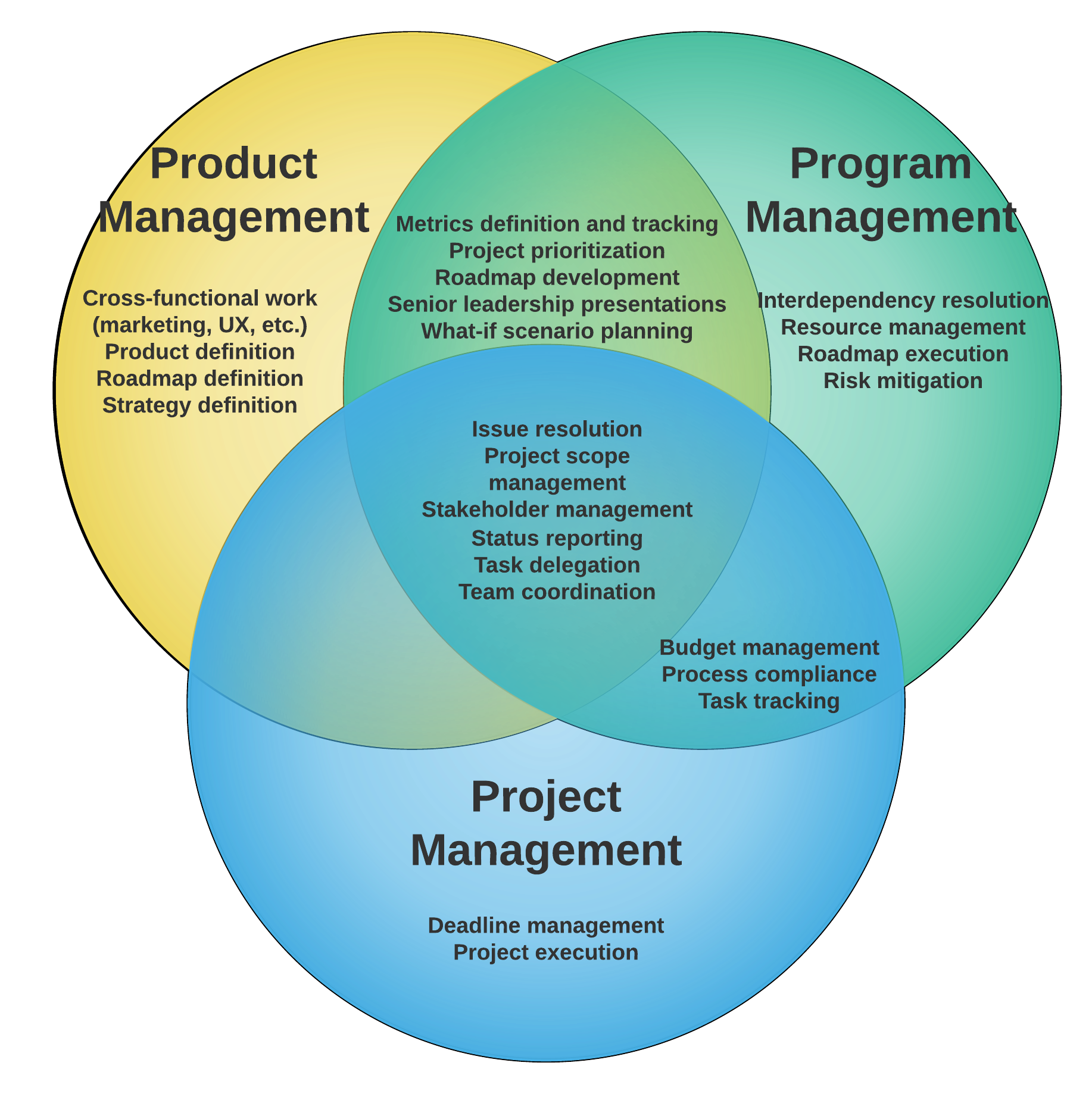
<p class="wp-block-paragraph"><strong>Project managers (PM or PjM) tend to own shorter-term projects, deliver a single deliverable, and coordinate a team to execute under budget, by the deadline and with the right quality</strong></p>


<p class="wp-block-paragraph"><strong>Program managers (PM or PgM) tend to work on longer-term projects, coordinate with a set of project managers, prioritize projects and are more responsible for resource coordination</strong> <strong>and overall execution</strong></p>


<p class="wp-block-paragraph"><strong>Product managers (PM) tend to do more definition around the product vision, strategy and roadmap, work with more cross-functional teams like marketing or UX, and are responsible for the product&#8217;s performance in the market</strong>. <strong>They tend to be closer to end users and their needs</strong></p>


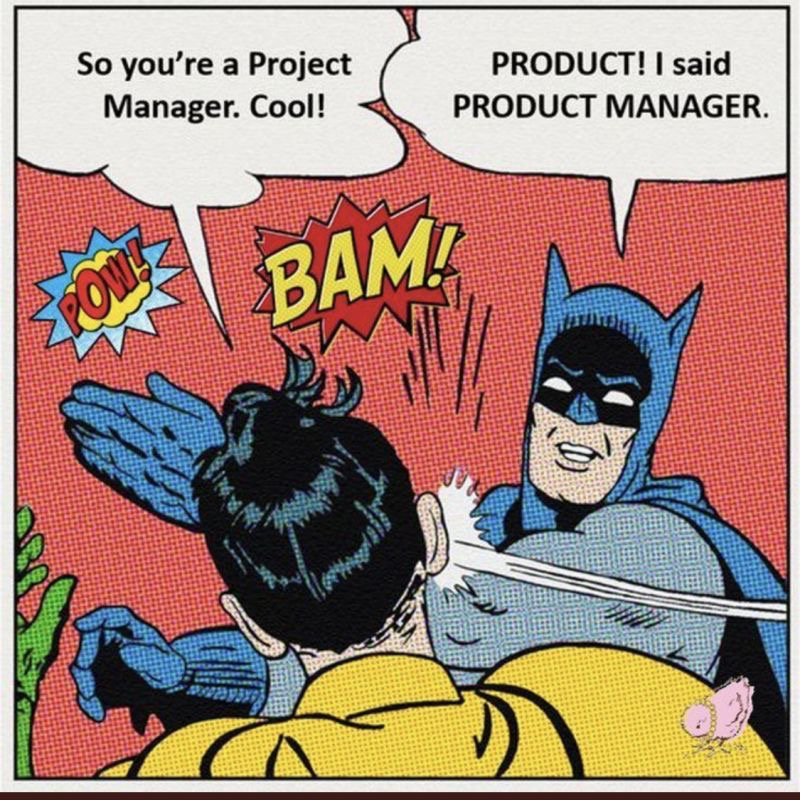
<div class="wp-block-image"><figure class="aligncenter size-large is-resized"><img loading="lazy" src="/assets/uploads/2025/02/6d436-img_3457.jpg" alt="" class="wp-image-458" width="324" height="324" /><figcaption>An all-too-familiar scenario for product managers.</figcaption></figure></div>


<h2 class="wp-block-heading">Similarities</h2>


<p class="wp-block-paragraph">It is easy to confuse these three roles &#8211; both by the PM acronym and their duties:</p>


<ul class="wp-block-list"><li>None of these roles actually manage anyone (despite the second word in their names)</li><li>Responsible for generally keeping an initiative on the rails</li><li>Delegate tasks</li><li>Coordinate teams</li><li>Manage stakeholders and report out the status of initiatives</li></ul>


<h2 class="wp-block-heading">Differences</h2>


<p class="wp-block-paragraph">But though they have some similarities, they have some <strong>key differences</strong> &#8211; even within those similarities. For example:</p>


<ul class="wp-block-list"><li>A product manager may define and delegate tasks that help define the roadmap, e.g. user research or design sprint. This is in part due to product managers being closer to end users and being more aware of their needs as a result</li><li>A program manager may work with finance to obtain budget for a program or set of projects &#8211; something not typically within a product manager&#8217;s purview</li><li>The issues they resolve also tend to be different. A product manager may resolve issues where a product feature is requiring a trade-off on schedule, cost or another feature. A program manager may resolve issues where a project is not landing in time for the next stage, and thus must determine how the budget, resources or other projects must shift to keep the program on the rails</li></ul>


<p class="wp-block-paragraph">It is important to note that, depending on the company, a product manager may take on responsibilities typically held by a program or project manager. At times, they may need to play the product and the program manager role. As described in <a href="/2020/05/23/what-is-product-management/">this post</a>, a product manager often needs to perform the duties of other roles.</p>


<h2 class="wp-block-heading">Salary</h2>


<p class="wp-block-paragraph">Each of these roles also have a technical version, e.g. Engineering Program Manager or Technical Product Manager (being technical tends to also come with a higher salary). Speaking of salary&#8230;</p>


<p class="wp-block-paragraph">Just how much do each of these roles earn? Averaging across the U.S., Indeed says:</p>


<ul class="wp-block-list"><li>Product managers top the list with an average of $106,725 </li><li>Project managers are next with an average of $86,462</li><li>Program managers have an average of $85,265</li></ul>


<p class="wp-block-paragraph">These numbers can shift based on the city the role is in, how technical it is, how senior the role is and which company you work for. In bay area tech companies, for example, averages seem to be considerably higher.</p>


<p class="wp-block-paragraph">Project managers also have an official certification process (<a href="https://www.pmi.org/certifications/types/project-management-pmp">PMP</a>) which can yield higher salaries. Program managers tend to also benefit, salary-wise, from going through this process. I have not personally  seen material compensation benefits for product managers to go through this process.</p>


<div class="wp-block-image"><figure class="aligncenter size-large is-resized"><img loading="lazy" src="https://i.pinimg.com/originals/81/bd/98/81bd98ea11b97c203a8881e013f0b23d.gif" alt="" width="468" height="351" /><figcaption>No comment.</figcaption></figure></div>


<p class="wp-block-paragraph">I hope this post has helped you to learn the differences between project, program and product management!</p>


<p class="wp-block-paragraph">Are you one of the &#8220;PM&#8221;s and feel like I missed something? Share your thoughts in the comments below!</p>]]></content><author><name>Kayiita Johansson</name></author><summary type="html"><![CDATA[]]></summary></entry><entry><title type="html">How technical does a product manager need to be?</title><link href="https://pmwhileblack.com/2020/08/03/how-technical-does-a-product-manager-need-to-be/" rel="alternate" type="text/html" title="How technical does a product manager need to be?" /><published>2020-08-03T05:41:11+00:00</published><updated>2020-08-03T05:41:11+00:00</updated><id>https://pmwhileblack.com/2020/08/03/how-technical-does-a-product-manager-need-to-be</id><content type="html" xml:base="https://pmwhileblack.com/2020/08/03/how-technical-does-a-product-manager-need-to-be/"><![CDATA[<p class="wp-block-paragraph">It is a fairly common question many of us ask ourselves when we are trying to break into product management: <em>how technical does a product manager need to be?</em></p>


<p class="wp-block-paragraph">When I was first getting into product, many people told me my background as a political science major would be a major liability.&nbsp; 5 years later as I begin to hire PMs for my own product organization, I can say definitively that you do NOT have to know how to code in any way, shape, or form to be a great product manager.&nbsp; You only need to be intellectually curious enough to conceptualize how technologies work and relate to each other.&nbsp;&nbsp;</p>


<p class="wp-block-paragraph">I examine this in a <a href="https://www.linkedin.com/pulse/how-technical-does-product-manager-need-meka-este-mcdonald/">longer post</a>, but I have condensed a summary here looking at the three components of building an <em>innovation conversion engine</em> that efficiently moves from generating ideas to execution. </p>


<h2 class="wp-block-heading">Product Discovery</h2>


<p class="wp-block-paragraph"><a href="http://svpg.com/product-discovery/">Product discovery</a> is the beginning of the funnel for an innovation conversion engine.&nbsp; It is the role of the product organization to not simply leave ideas up to chance, but to <em>systematically</em> capture ideas and decide which should move forward in the funnel.&nbsp; This could <a href="http://svpg.com/product-discovery-vs-product-optimization/">move along many different tracks, </a>from discovering new feature ideas that will optimize a current product to discovering an opportunity for an entirely new product.&nbsp;</p>


<p class="wp-block-paragraph">I think it is important to distinguish between two types of discovery: technological innovation and application innovation.&nbsp; Technological innovation is an idea that expands the boundaries of what is currently thought possible (i.e. self-driving cars), and it is the type where technical experience seems most advantageous.&nbsp; However, the role of product, even in such a frontier, is still that of an intermediary between the customers and the technology.&nbsp; That means it is their job to understand the<em> opportunity (the what)</em> that breakthrough represents and use that to guide further R&amp;D, and then to collaborate with their tech leads on <em>how.</em>&nbsp;&nbsp;</p>


<figure class="wp-block-image size-large"><img src="/assets/uploads/2025/02/4e1f3-zoox_car.jpg" alt="" class="wp-image-381" /></figure>


<p class="wp-block-paragraph">And this is also true of the more common types of innovation, which involve new application and creative coordination of existing technology.&nbsp; Again, product is the intermediary between what is possible and what is needed.&nbsp; Spending a year as an iOS developer 5 years ago doesn’t make me any more qualified to look at the logistics domain and discuss with my CTO if blockchain is an applicable technology for our product goals.&nbsp;&nbsp;&nbsp;</p>


<p class="wp-block-paragraph">Really, product discovery is about gap analysis, something that is extremely prevalent in both liberal arts research and technical research. For those of you aspiring to be the first PM at an early-stage startup, or management level PM (director, VP, CPO), demonstrating the capacity to learn new domains quickly and research them for gaps is going to be much more important than whether you are technical or not.  Most PM roles will be more focused on ideation and execution within the scope of the product discovery done by senior leadership, which we address next.  </p>


<h2 class="wp-block-heading">Execution and Product/Market Fit</h2>


<p class="wp-block-paragraph">After the innovation conversion engine has generated an idea, the rest of the funnel could be described as an ever-tightening loop between execution and market feedback.</p>


<p class="wp-block-paragraph">Day to day execution does involve a number of activities where technical communication is important.&nbsp; Yet, almost all these activities are collaboratively done: specs with engineers, mockups with designers, deadlines with business execs, etc.&nbsp; Coordinating all this specialized expertise to create a plan, and to make calculated trade-offs, is a process where soft skills are more important.</p>


<p class="wp-block-paragraph"><a href="http://svpg.com/product-market-fit/">Fitting the product to the market </a>is about research design. Once again, research design has little to no correlation to experience as a technical individual contributor.&nbsp; In fact, qualitative research of this kind, research on people, is primarily a skillset you’d find in the social sciences.&nbsp; This tells me that companies should be looking for PMs with research design capacity mixed with the communication skills necessary for coordination and specification in execution.&nbsp;</p>


<figure class="wp-block-image size-large"><img src="/assets/uploads/2025/02/fdd27-puzzle.jpeg" alt="" class="wp-image-382" /></figure>


<p class="wp-block-paragraph"></p>


<h2 class="wp-block-heading">Leadership and Communication</h2>


<p class="wp-block-paragraph">One thing that makes product so difficult is that many departments, teams, and stakeholders are accountable to the product org who pulls it all together as a coherent, executable whole.&nbsp; But, none of them report to you, which means you have to lead with influence rather than authority.</p>


<p class="wp-block-paragraph">To do this well, PMs must be able to understand specific execution questions within the broader context of the following flow:</p>


<p class="wp-block-paragraph"><a href="http://svpg.com/business-strategy-vs-product-strategy/"><em>Business Strategy </em></a><em>&#8211;&gt; </em><a href="http://svpg.com/product-strategy-in-an-agile-world/"><em>Product Vision</em></a><em> &#8211;&gt; </em><a href="http://svpg.com/product-roadmaps/"><em>Product Roadmap</em></a></p>


<p class="wp-block-paragraph">This is a conceptual skill, to hold a mental model of different layers ranging from the very abstract to the specific existing within each other in concentric circles.  To collaboratively work through trade-offs in the execution process, with stakeholders who often have incentives that are directly at odds, takes a deft touch born of a nuanced understanding of the bigger picture.  Technical experience does nothing to explicitly prepare you for this.</p>


<h2 class="wp-block-heading">Conclusion</h2>


<p class="wp-block-paragraph">To be successful, product orgs need to exhibit strong capacity for a variety of conceptual thinking skills, from gap analysis, to technical communication, to research design, to the leadership necessary to hold multiple stakeholders accountable.&nbsp; If you want someone with the capacity to grow into a good approximation of the &#8220;whole package&#8221;, I think it’s just as likely a non-technical person can learn to fill in their gaps as a nominally technical person.&nbsp;</p>]]></content><author><name>Meka</name></author><summary type="html"><![CDATA[It is a fairly common question many of us ask ourselves when we are trying to break into product management: how technical does a product manager need to be?]]></summary></entry><entry><title type="html">A deep dive on the founder of PM While Black (podcast)</title><link href="https://pmwhileblack.com/2020/07/15/a-deep-dive-on-the-founder-of-pm-while-black-podcast/" rel="alternate" type="text/html" title="A deep dive on the founder of PM While Black (podcast)" /><published>2020-07-15T04:48:28+00:00</published><updated>2020-07-15T04:48:28+00:00</updated><id>https://pmwhileblack.com/2020/07/15/a-deep-dive-on-the-founder-of-pm-while-black-podcast</id><content type="html" xml:base="https://pmwhileblack.com/2020/07/15/a-deep-dive-on-the-founder-of-pm-while-black-podcast/"><![CDATA[<p class="wp-block-paragraph">Listen to Google Product Manager and Founder of PM While Black, Kayiita Johnson, share his story on <a href="http://www.december26er.com">December26er</a>. He discusses setting his sights on an engineering career at a very young age, broadening his professional interests and obtaining his MBA from Stanford, and creating a platform to help make product management careers more accessible to the Black community.</p>


<p class="wp-block-paragraph"></p>


<iframe width="100%" height="300" scrolling="no" frameborder="no" src="https://w.soundcloud.com/player/?url=https%3A%2F%2Fapi.soundcloud.com%2Ftracks%2F857520322&#038;auto_play=false&#038;hide_related=false&#038;visual=true&#038;show_comments=true&#038;show_user=true&#038;show_reposts=false&#038;color=ff5500"></iframe>
<div style="font-size: 10px;color: #cccccc;overflow: hidden;font-family: Interstate,Lucida Grande,Lucida Sans Unicode,Lucida Sans,Garuda,Verdana,Tahoma,sans-serif;font-weight: 100"><a href="https://soundcloud.com/user-832379294-223527529" title="The December 26er Podcast" target="_blank" style="color: #cccccc;text-decoration: none" rel="noopener noreferrer">The December 26er Podcast</a> · <a href="https://soundcloud.com/user-832379294-223527529/episode-128-interview-with-kayiita-johnson" title="Episode 128: Interview with Kayiita Johnson" target="_blank" style="color: #cccccc;text-decoration: none" rel="noopener noreferrer">Episode 128: Interview with Kayiita Johnson</a></div>]]></content><author><name>Kayiita Johansson</name></author><summary type="html"><![CDATA[Listen to Google Product Manager and Founder of PM While Black, Kayiita Johnson, share his story on December26er. He discusses setting his sights on an engineering career at a very young age, broadening his professional interests and obtaining his MBA from Stanford, and creating a platform to help make product management careers more accessible to the Black community.]]></summary></entry><entry><title type="html">New promotion: Emmanuel Yirenkyi</title><link href="https://pmwhileblack.com/2020/06/25/new-promotion-emmanuel-yirenkyi/" rel="alternate" type="text/html" title="New promotion: Emmanuel Yirenkyi" /><published>2020-06-25T06:00:00+00:00</published><updated>2020-06-25T06:00:00+00:00</updated><id>https://pmwhileblack.com/2020/06/25/new-promotion-emmanuel-yirenkyi</id><content type="html" xml:base="https://pmwhileblack.com/2020/06/25/new-promotion-emmanuel-yirenkyi/"><![CDATA[<p class="wp-block-paragraph">Congratulations, Emmanuel! He recently became a product manager at TransferWise, Europe&#8217;s leading FinTech unicorn. He is leading the global expansion of their product for the Middle East and Africa! He was previously a PM at mPharma, a leading Health Tech startup in Africa which manages prescription drug inventory for pharmacies and their suppliers. He is now based in Tallinn, Estonia.</p>


<p class="wp-block-paragraph">Connect with him on LinkedIn <a href="https://www.linkedin.com/in/eyirenkyi">here</a>.</p>]]></content><author><name>Kayiita Johansson</name></author><summary type="html"><![CDATA[Congratulations, Emmanuel! He recently became a product manager at TransferWise, Europe&#8217;s leading FinTech unicorn. He is leading the global expansion of their product for the Middle East and Africa! He was previously a PM at mPharma, a leading Health Tech startup in Africa which manages prescription drug inventory for pharmacies and their suppliers. He is now based in Tallinn, Estonia.]]></summary></entry><entry><title type="html">How to come up with a killer product idea</title><link href="https://pmwhileblack.com/2020/06/23/how-to-come-up-with-a-killer-product-idea/" rel="alternate" type="text/html" title="How to come up with a killer product idea" /><published>2020-06-23T09:00:00+00:00</published><updated>2020-06-23T09:00:00+00:00</updated><id>https://pmwhileblack.com/2020/06/23/how-to-come-up-with-a-killer-product-idea</id><content type="html" xml:base="https://pmwhileblack.com/2020/06/23/how-to-come-up-with-a-killer-product-idea/"><![CDATA[<p class="wp-block-paragraph">Innovators often declare you can never create a bold, disruptive idea and company by conducting user research &#8211; I couldn&#8217;t disagree more. The key is in how you conduct, and how you use, said user research. </p>


<p class="wp-block-paragraph">I have conducted this workshop on for kick-starting your user research for product managers several times and gotten positive feedback. Hopefully this is helpful to you as you think about your own killer product idea!</p>


<iframe src="https://docs.google.com/presentation/d/e/2PACX-1vRBoaEtarORL5l6Gtkz8LlWMTMe5-V7UYzl6fnfpqGrTXtEGey4eS6EEYc96yOjYzK5SdOkZEUYWZ38/embed?start=false&#038;loop=true&#038;delayms=3000" frameborder="0" width="960" height="569" marginheight="0" marginwidth="0" allowfullscreen="true" mozallowfullscreen="true" webkitallowfullscreen="true"></iframe>]]></content><author><name>Kayiita Johansson</name></author><summary type="html"><![CDATA[Innovators often declare you can never create a bold, disruptive idea and company by conducting user research &#8211; I couldn&#8217;t disagree more. The key is in how you conduct, and how you use, said user research.]]></summary></entry><entry><title type="html">New PM: Gozi Uzoma</title><link href="https://pmwhileblack.com/2020/06/04/new-pm-gozi-uzoma/" rel="alternate" type="text/html" title="New PM: Gozi Uzoma" /><published>2020-06-04T14:46:51+00:00</published><updated>2020-06-04T14:46:51+00:00</updated><id>https://pmwhileblack.com/2020/06/04/new-pm-gozi-uzoma</id><content type="html" xml:base="https://pmwhileblack.com/2020/06/04/new-pm-gozi-uzoma/"><![CDATA[<p class="wp-block-paragraph">Congratulations, Gozi! She joined the <a href="https://www.box.com/">Box</a> through their Rotational Leadership Program post business school,  did 2 of her 3 rotations as a PM, and then was formally hired as a product manager. She is now based in San Francisco, California.</p>


<p class="wp-block-paragraph">Connect with her on LinkedIn <a href="https://www.linkedin.com/in/ngozika-gozi-uzoma-01483640/">here</a>.</p>]]></content><author><name>Kayiita Johansson</name></author><summary type="html"><![CDATA[Congratulations, Gozi! She joined the Box through their Rotational Leadership Program post business school, did 2 of her 3 rotations as a PM, and then was formally hired as a product manager. She is now based in San Francisco, California.]]></summary></entry><entry><title type="html">Prep for PM interviews at large tech firms</title><link href="https://pmwhileblack.com/2020/05/24/prep-for-pm-interviews-at-large-tech-firms/" rel="alternate" type="text/html" title="Prep for PM interviews at large tech firms" /><published>2020-05-24T03:32:41+00:00</published><updated>2020-05-24T03:32:41+00:00</updated><id>https://pmwhileblack.com/2020/05/24/prep-for-pm-interviews-at-large-tech-firms</id><content type="html" xml:base="https://pmwhileblack.com/2020/05/24/prep-for-pm-interviews-at-large-tech-firms/"><![CDATA[<figure class="wp-block-image is-resized"><img loading="lazy" src="https://images.unsplash.com/photo-1584259432689-f6894ce102be?ixlib=rb-1.2.1&amp;ixid=eyJhcHBfaWQiOjEyMDd9&amp;auto=format&amp;fit=crop&amp;w=1000&amp;q=80" alt="white and brown wooden staircase" width="750" height="563" /><figcaption><em>Everybody wants to be a PM, nobody wants to put the work in &#8211; anonymous</em></figcaption></figure>


<p class="wp-block-paragraph">So you have been diligent on your path to product management and you have landed a product management interview at a large tech company! Congratulations! Now, how do we make sure you ace this thing?</p>


<p class="wp-block-paragraph">Product management interviews are unique in that it is really about how you think than anything else. After a certain fundamental level of technical knowledge, it is all about your user-centric approach, your structured reasoning, and strong communication skills despite adversity.</p>


<h3 class="wp-block-heading">Technical Knowledge</h3>


<p class="wp-block-paragraph">This tends to be the part of PM interviews candidates stress out about most. The reality is, it really depends company to company, and team to team. Some projects will be highly technical and will require the product manager to really know their stuff. Some projects are much closer to operations, for example, where coding is optional at best. I will try to give you a more conservative set of skills so you&#8217;ll be moderately well prepared for most interviews.</p>


<p class="wp-block-paragraph">I recommend purchasing <a href="https://www.amazon.com/gp/product/0984782850/ref=as_li_tl?ie=UTF8&amp;camp=1789&amp;creative=9325&amp;creativeASIN=0984782850&amp;linkCode=as2&amp;tag=pmwhileblack-20&amp;linkId=5d7a170401a4148f70f18a396728dc77"><strong>Cracking the coding interview</strong></a>. Generally, it&#8217;s important you understand the structure of a mobile app, and solving beginner-to-intermediate coding problems that leverage data structures and algorithms knowledge, and the ability to reduce complexity (big-O notation). This book is great for ramping on these areas, so definitely read through it. Also, <strong>do the problems. </strong>You won&#8217;t retain anything unless you do!</p>


<h3 class="wp-block-heading">User-centric Approach</h3>


<p class="wp-block-paragraph">A big part of product management is being the voice of the user/customer. There will be many meetings where colleagues will be optimizing for different things, and you will have to step in to advocate for the user. Ideally this starts early with your product requirements document (PRD), but you will likely have to do this throughout a product/feature&#8217;s development. Thus, testing for this is paramount in a PM interview.</p>


<p class="wp-block-paragraph">To get a good handle on this, I would recommend two things:</p>


<ol class="wp-block-list"><li>Learn the CIRCLES framework. Though not universally used, it is a really solid framework that helps ground you and focus on the pain points you are solving, the journey the user is going through and solutions you craft based on that. <a href="https://www.impactinterview.com/2016/06/circles-method-product-design-framework/"><strong>This</strong></a> is a good resource for learning CIRCLES</li><li>Doing product design questions. I recommend purchasing the <a href="https://www.amazon.com/gp/product/0984782818/ref=as_li_tl?ie=UTF8&amp;camp=1789&amp;creative=9325&amp;creativeASIN=0984782818&amp;linkCode=as2&amp;tag=pmwhileblack-20&amp;linkId=8e7ded6660fca2cd6504621b29b5ecfe"><strong>Cracking the PM interview</strong></a> book. It has good content on design questions and good answer structure &#8211; again, <strong>make sure you actually do the problems! Don&#8217;t just read the answers.</strong></li></ol>


<h3 class="wp-block-heading">Structured Reasoning</h3>


<p class="wp-block-paragraph">The idea here is really being able to take on complex problems where there isn&#8217;t a clear solution, and craft an answer that is logical and makes sense. The great thing is, this is the core of all management consulting interviews! <a href="https://www.amazon.com/gp/product/0986370746/ref=as_li_tl?ie=UTF8&amp;camp=1789&amp;creative=9325&amp;creativeASIN=0986370746&amp;linkCode=as2&amp;tag=pmwhileblack-20&amp;linkId=f2b8f4d643187395dd829b2909b15d35"><strong>Case In Point</strong></a> is a great resource for learning how to structure case interview answers and arriving at a logical answer. Read through the book and read maybe 20% of the questions and answer, and then, again, <strong>do the questions. </strong>Do not skip on the more quantitative ones, either! Those may be where most of the value is for product management interviews.</p>


<p class="wp-block-paragraph">If you are in business school and you have time, I would highly recommend you do case prep with folks preparing for consulting interviews.</p>


<h3 class="wp-block-heading">Strong Communication Skills</h3>


<p class="wp-block-paragraph">The key here is being confident and making sure to share your thought process out loud. Again, PM candidates are getting their thought process evaluated, so share it!</p>


<p class="wp-block-paragraph">For fundamentals, I would suggest practicing your behavior interviewing techniques. My personal favorite is the <a href="https://www.indeed.com/career-advice/interviewing/how-to-use-the-star-interview-response-technique"><strong>STAR technique</strong></a>. This is to help structure answers to questions like, &#8220;Tell me about a time you had to lead a group of peers&#8221;.</p>


<h3 class="wp-block-heading">Mock Interviews</h3>


<p class="wp-block-paragraph">Do not underestimate the value and importance of mock interviews! It is one thing to read through the resources I suggest, and another to truly internalize them. Do mock interviews with friends that are PMs, or are engineers that work with PMs. There is also <a style="font-weight: bold" href="http://pmint.herokuapp.com/">this</a> Slack community I have heard about that coordinates virtual interviews. Could be worth checking out.</p>


<p class="wp-block-paragraph">If you want to have a comprehensive prep experience and go through sample interview questions, mock interviews and analysis, I would suggest trying out <a href="https://www.tryexponent.com/pm?promo_code=PMWHILEBLACK">Exponent</a>. For the PM While Black community, they have offered 20% off their programs so check it out <a href="https://www.tryexponent.com/pm?promo_code=PMWHILEBLACK">here</a>!</p>


<h3 class="wp-block-heading">Final Thoughts</h3>


<p class="wp-block-paragraph">Assuming you have done all the prep work listed here, just relax and be confident. You have prepped as best you can, and now you just need to connect with the interviewer and get excited about their questions. PM interviews are often pretty fun and engaging!</p>


<p class="wp-block-paragraph">If you have contacts at the companies you are interested in, I would speak to product managers at those companies to get their insights.</p>


<h3 class="wp-block-heading">Other Resources</h3>


<p class="wp-block-paragraph">I was sent these two infographics years ago and they provide great overviews of the kinds of work that needs to be done and prepared for ahead of PM interviews:</p>


<p class="wp-block-paragraph"><img loading="lazy" width="590" height="459" src="https://lh3.googleusercontent.com/D-L8w7svMVLc3cbWmHUiz9bP7cgnIzz467LYX8O_5k5y6jvVlywSUSBxF4OaydXKsZ9iOZIhousq-V_7h3SvDsfbfJZr7LV7e4bzbesnmHsOExNecbCfVzJjDo3ycVUzQJ359EsD"></p>


<p class="wp-block-paragraph"><img loading="lazy" src="https://lh5.googleusercontent.com/2zTJIUoZUfnVeU3q8bwqNVvagYP1dX1AMO5n7vCxByJ6xxcdptFfLbpJthfSAh5ARGH6tHeNzYy2VGVdv50lwC8Bmu6rqAZ73J65b7KAzllTd7vTaJQxO1nedHJ7_A0yWN5aJAbN" width="568" height="424"></p>]]></content><author><name>Kayiita Johansson</name></author><summary type="html"><![CDATA[Everybody wants to be a PM, nobody wants to put the work in &#8211; anonymous]]></summary></entry><entry><title type="html">PM while WFH during the COVID-19 pandemic</title><link href="https://pmwhileblack.com/2020/05/24/pm-while-wfh-during-the-covid-19-pandemic/" rel="alternate" type="text/html" title="PM while WFH during the COVID-19 pandemic" /><published>2020-05-24T02:15:25+00:00</published><updated>2020-05-24T02:15:25+00:00</updated><id>https://pmwhileblack.com/2020/05/24/pm-while-wfh-during-the-covid-19-pandemic</id><content type="html" xml:base="https://pmwhileblack.com/2020/05/24/pm-while-wfh-during-the-covid-19-pandemic/"><![CDATA[<div class="wp-block-image is-style-default"><figure class="alignleft is-resized"><img loading="lazy" src="https://images.pexels.com/photos/4260761/pexels-photo-4260761.jpeg?auto=compress&amp;cs=tinysrgb&amp;h=750&amp;w=1260" alt="Family Looking at a Laptop" width="198" height="296" /></figure></div>


<p class="wp-block-paragraph">The Coronavirus pandemic is disproportionately affecting our community&#8217;s health and economic outlook, and has once again made stark just how systemically racist America is. These are the issues we should be discussing and acting upon, and I hope you are finding ways to support your community.</p>


<p class="wp-block-paragraph">Though it is a much less grave and dire an issue, it is important to address how the nature of PM changes when many of us are now following shelter-in-place (SIP) orders and working from home (WFH). Product management is challenging to do remotely when so much of the role is ensuring you are there to fill the gaps. Here are some tips and strategies to improve your efficacy as a remote PM:</p>


<h3 class="wp-block-heading">More informal modes of communication, and increase your responsiveness</h3>


<p class="wp-block-paragraph">Gone are the days when you would be able to quickly swing by someone&#8217;s desk, or catch them after a meeting. As a result, the friction to start a conversation has grown. As PMs, we need to make sure we not only create channels for the team to communicate, but also create a culture of responsiveness so the team can be as efficient as possible:</p>


<ul class="wp-block-list"><li>Go beyond email. Create group chats on specific work streams or initiatives</li><li>Create status docs you update and share with others so they can stay abreast of what is going on</li><li>Not every video call or meeting needs to be 30 minutes or an hour. Create shorter meetings to help the team stay effective</li><li>For yourself, establish a time-to-respond requirement for each mode and hold yourself to it to role model the new norms in this dynamic environment</li></ul>


<h3 class="wp-block-heading">Be more considerate</h3>


<p class="wp-block-paragraph">I think sometimes we let whatever we have going on drown out our empathy for other situations in this time. If you have kids, it&#8217;s good to acknowledge the difficult aspects of social isolation your colleagues living alone may be going through. If you do not have a family, it&#8217;s important to remember that, in many areas, childcare is no longer available so your colleagues may be balancing writing that doc with teaching their kids their daily lesson. Showing more empathy to others <em>and yourself</em> is critical to ensure this new normal is sustainable:</p>


<ul class="is-style-default wp-block-list"><li>In the beginning of your meetings, ask the attendees how they are doing. Recognize and affirm others while in meetings</li><li>Label your communications with your expectation on time-to-response to help your colleagues triage and not feel like they need to respond ASAP in certain cases</li></ul>


<h3 class="wp-block-heading">Prioritize</h3>


<p class="wp-block-paragraph">This is usually the name of the game for product managers, but is even more so in these times:</p>


<ul class="wp-block-list"><li>Prioritize your calendar. Do you really need to be at that 100-person meeting? Does that 1:1 need to happen every week? Having people add agendas to calendars can do wonders for opening up space on your schedule</li><li>Prioritize your team&#8217;s efforts. Is everything you and your team were planning to do truly important? Are there areas that can be punted to later? How can you help shield the team from feature creep in a time where efficiency is already lower than normal?</li></ul>


<h3 class="wp-block-heading">Maintain or better define your work/life balance</h3>


<p class="wp-block-paragraph"> This is an area everyone talks about, but I&#8217;m not sure anyone&#8217;s fully cracked. It&#8217;s critical, especially in these times, to avoid burning out. This could be perceived as being in direct tension with the increased responsiveness point above&#8230;to which I&#8217;d say it&#8217;s a balancing act based on your company, workload etc. but there are still concrete actions you can take to improve it:</p>


<ul class="wp-block-list"><li>Set a recurring invite for some longer activity you do around 6 or when you get off to really help you physically separate from your work devices</li><li>Set do-not-disturb routines on your work devices to keep that late-night ping from bringing you back into work mode</li><li>Set daily checklists and do not let tomorrow&#8217;s actions leak into today&#8217;s</li></ul>


<h3 class="wp-block-heading">Lighten the mood when you can</h3>


<p class="wp-block-paragraph">Everyone&#8217;s going through a lot, and sometimes it can be your role to pick up the mood 🙂</p>


<ul class="wp-block-list"><li>Set virtual happy hours for your team. Perhaps have a theme for every week, e.g. bring your favorite drink or share your favorite SIP TV show</li><li>If kids emerge on screen, play along! This is the new normal, so make it feel cool. Make a joke or ask for their insight into this feature</li></ul>]]></content><author><name>Kayiita Johansson</name></author><summary type="html"><![CDATA[]]></summary></entry></feed>